Creating Teaching Materials and Examples of their Use
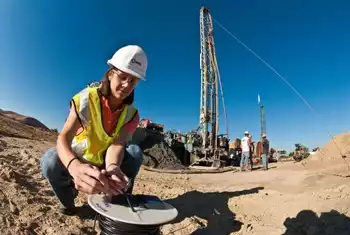
All of these materials:
- address one or more grand challenges involving the Earth and society,
- develop student ability to address interdisciplinary problems,
- improve student understanding of the nature and methods of science and developing geoscientific habits of mind,
- make use of authentic and credible science data to learn central concepts in the context of scientific methods of inquiry, and,
- incorporate systems thinking.
These five items are referred to as the InTeGrate materials design principles.
Materials Development Teams
All InTeGrate teaching materials are developed and tested by teams of faculty drawn from at least three institutions. By engaging faculty who teach different kinds of students in different types of institutional settings in collaborative development of materials, we strive to create robust, flexible materials that can be used effectively in a wide variety of settings. This is key to creating materials that can be adopted easily by faculty who are not involved in the development.
The team-based materials development process, which includes review using the Materials Development Rubric (Microsoft Word 2007 (.docx) 113kB Jan18 14) and collection of project wide assessment data, has an added benefit of increasing faculty skill in materials development, teaching, and evaluation of student learning. It also encourages cross-institutional collaborations and leads to the development of more interdisciplinary and cross-disciplinary teaching materials.
Each team develops and tests materials during a two year interval. Team members commit to participating in the collaborative design and development of materials, piloting and testing these materials at their home institution, and revising and refining the materials based on the results of testing. In addition, they are responsible for completing a comprehensive set of documentation that supports other faculty in using the materials, including a description of the use of the materials in their own classrooms.
Teams are supported in their work by a team leader who provides overall guidance and is a member of the project leadership team, an assessment consultant who assists the team in meeting the materials development rubric and in interpreting the testing results, the project internal assessment team who assist in the data collection effort during testing, and a member of the SERC webteam who assists with use of the content management system to create and publish materials and to manage the interactions among the team.
 Show more about the materials development process
 Hide
HideTypes of Materials Developed
InTeGrate materials are in three target areas:
- Introductory geoscience courses. These materials are designed for use in traditional introductory geoscience courses as well as in environmental science, AP environmental science, and dual credit geoscience courses.
- Interdisciplinary courses across the curriculum. These materials are designed for use in courses that are interdisciplinary as well as to bring interdisciplinary elements into courses that are central to disciplinary majors.
- Courses for future teachers. These materials are designed for both the elementary and secondary curriculum addressing content and methods.
Development teams are on two scales: modules and courses. Modules are topical units of instruction lasting longer than a week but less than a full term. These scales allow flexibility in addressing the spectrum of curricular opportunities and needs. Where appropriate, modules are designed so that a set can be used to teach a full course.
The InTeGrate materials development effort planned to engage over 150 faculty from across the nation including no fewer than 25 faculty from two year colleges and minority serving institutions, including historically black colleges and universities and tribal colleges and universities. To ensure broad participation from the full spectrum of institutions across the nation, 75 positions were filled using an application process. The balance of positions were filled by invitation. The professional development program plays an important role in identifying both needed materials and potential team members. See the list of modules and courses that have been developed.
Several InTeGrate workshops are aimed at building an understanding of current teaching practices surrounding a topical of high interest to InTeGrate. These workshops include:
- Systems, Society, Sustainability and the Geosciences
- Teaching Environmental Justice: Interdisciplinary Approaches
- Engineering, Sustainability, and the Geosciences
- GeoEthics Workshop
- Teaching about Risk and Resilience: Sea Level Rise, Flooding, and Earthquakes
A major goal of these workshops is creating interdisciplinary communities that can engage in developing new types of interdisciplinary materials addressing geoscience and societal issues. To date, more than 15 workshop participants are involved in materials development teams that have been funded by the project. More broadly, the professional development program is building a base of information that can be drawn upon to develop quality proposals for new materials.
Format of Teaching Materials

- detailed learning goals and information about the teaching context for which the course/module is appropriate; where it fits in the curriculum.
- a detailed narrative of the overall course/module with specific activities fleshed out in SERC activitysheet format.
- guidance on assessing student learning of the material, including access to the full assessment tools used by the original developers.
- reflections from the original authors about how the materials played out in their classrooms.
The student materials take several forms:
- Handouts, datasets and other downloadable materials will be provided within the activitysheets. Instructors are free to adapt these for their local circumstances, providing them to their students in print or electronically. e.g. via their local Learning Management System (LMS).
- Background readings and other original supporting materials will be available as web pages directly on the InTeGrate website. Faculty can point their students to separate student-focused versions of these materials, or download them for display in a local website or LMS. InTeGrate will provide stable versions of each revision of these materials as well as downloadable versions as html5 and in common cartridge format.
InTeGrate materials are available at no cost under a creative commons license that encourages wide reuse and empowers educators to flexibly adapt the materials to meet their local needs. Copyright of original materials developed by InTeGrate is retained by the project.
- Egger A.E., Bruckner M.Z., Birnbaum S.J., Gilbert L.A. (2019) Facilitating the Development of Effective Interdisciplinary Curricular Materials. In: Gosselin D., Egger A., Taber J. (eds) Interdisciplinary Teaching About Earth and the Environment for a Sustainable Future. AESS Interdisciplinary Environmental Studies and Sciences Series. Springer, Cham
- Steer D., Iverson E.R., Egger A.E., Kastens K.A., Manduca C.A., McConnell D. (2019) The InTeGrate Materials Development Rubric: A Framework and Process for Developing Curricular Materials that Meet Ambitious Goals. In: Gosselin D., Egger A., Taber J. (eds) Interdisciplinary Teaching About Earth and the Environment for a Sustainable Future. AESS Interdisciplinary Environmental Studies and Sciences Series. Springer, Cham